
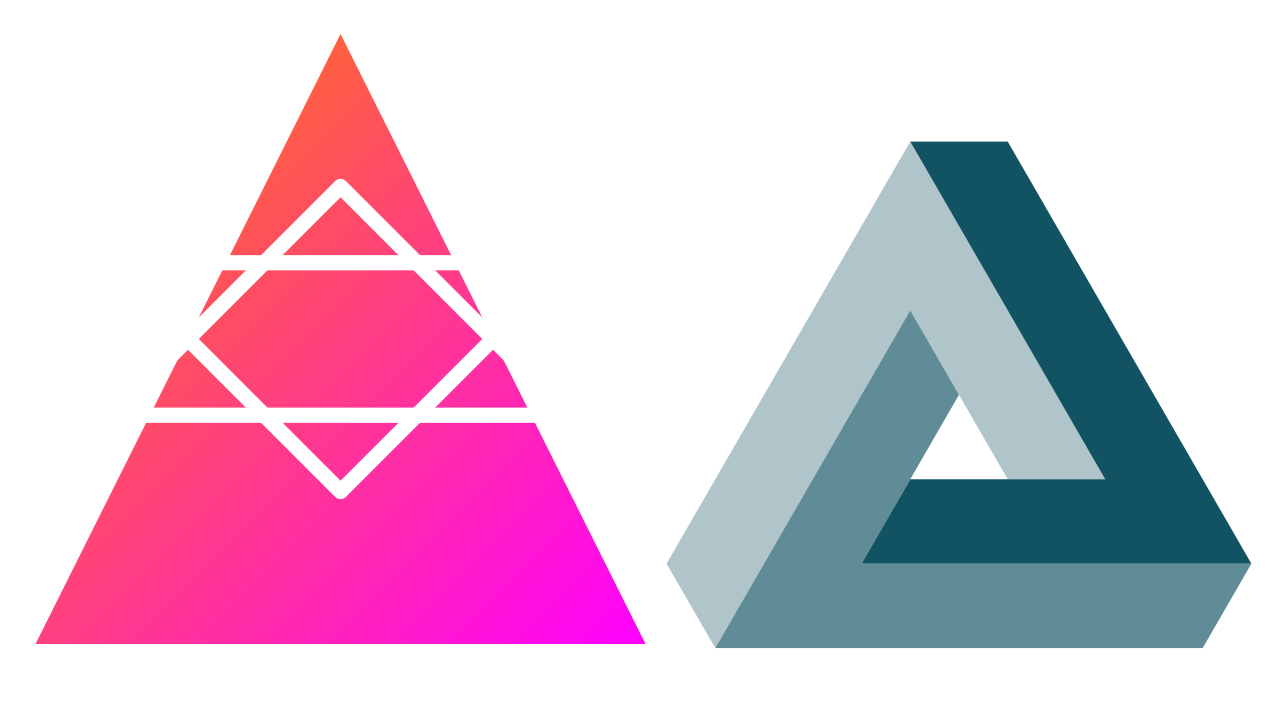
I went looking for the edge of the new toy. Everyone in March 2023 was busy asking ChatGPT to write their cover letters and rename their startups; I wanted to find the wall it would walk into. So I asked it to draw a thing that cannot exist.
The Penrose triangle. Three beams that join at right angles into a closed loop your eye accepts and your geometry rejects. It is the kind of object you can sketch in two minutes and never actually build. I picked it precisely because it is simple to look at and impossible to be. If a machine “understands” 3D space the way I do, this should be a layup.
It was not a layup.
The thing it got right was the thing I least expected
Before I get to the failure, credit where it’s due, because the shape of what it got right is the whole point.
Ask ChatGPT what a Penrose triangle is and it answers like a tired professor who has explained this a hundred times. The optical illusion, the impossible object, the way each corner is locally consistent while the whole is globally contradictory — all correct, all fluent. It knew the word “impossible” and used it in the right places.
Then I asked it to render one as an SVG, and it handed me a triangle. A regular, entirely possible, three-sides-meet-in-a-plane triangle. The text described an impossible object with confidence; the drawing was a shape any kindergartener makes by accident.
That gap — perfect description, broken depiction — is the part I keep coming back to. It is the image at the top of this post: on the left, what ChatGPT drew; on the right, the one I eventually cut by hand in Inkscape after an embarrassing number of hours. The machine produced its version in seconds and was wrong. I produced mine slowly and it was right. I am not sure either of us should feel great about that.
Confidently wrong is the default setting
The other thing that stuck with me wasn’t the geometry. It was the tone.
Every wrong answer arrived with the same even, helpful confidence as every right one. There was no flicker of doubt, no “this might be off,” no hedging where a human would hedge. It described an impossible figure, drew a possible one, and would have happily drawn me a hundred more, each one wrong, each one delivered like settled fact.
That is the actual lesson, and it has nothing to do with triangles. The failure mode of this tool is not that it can’t do things. It’s that it sounds exactly the same whether it can or can’t. The Penrose triangle is one case where I happen to be able to see the wrongness. Most of the time I won’t be able to, and it will sound just as sure.
So the practical rule I walked away with in 2023: treat fluency and correctness as two separate dials, and never assume one is reporting on the other.
Why a drawing program in your head beats one trained on the internet
Here is my best guess at why it fails, and I’ll flag it as a guess rather than established fact.
When I imagine the Penrose triangle, I don’t retrieve it — I sort of build it. I run a little spatial simulator, rotate the thing, notice where the beams refuse to meet, and feel the contradiction as a kind of friction. The “impossible” is something I experience, not something I looked up.
A language model trained on text and images doesn’t have that simulator. It has seen the words about impossible objects and, increasingly, pictures of them, and it predicts what usually comes next. That’s astonishing for a huge range of tasks. But “what usually comes next after a triangle” is a normal triangle, because normal triangles vastly outnumber impossible ones in everything it ever read. The illusion lives in the spatial relationships, and the relationships are exactly the part that pattern-matching smooths over.
That’s not a bug to be patched out next Tuesday. It’s a difference in kind. I solve the triangle by seeing; it solves the triangle by recalling. Most days those two routes land in the same place, which is why the tool feels like magic. The Penrose triangle is one of the places they don’t.
A 2025 look back
I’m writing this addendum nearly three years after the original. The models have changed a lot, so I went back and ran the test again. What follows is my own read of where things stood in late 2025 — historical opinion, not a fresh benchmark — so take the model names as a snapshot, not a leaderboard.
The first thing to say: the gap got narrower and did not close.
By 2025, asking a current model about the Penrose triangle was even more impressive on the description side. It could walk through the depth cues, the perspective trick, the math of why your eye is being lied to. The SVG it generated was cleaner — better structure, fewer syntax stumbles, and with patient, iterative feedback it could be pushed toward something that reads as the illusion.
But “with patient, iterative feedback” is doing a lot of work in that sentence. The thing I had to supply was still the thing it lacked in 2023: the spatial judgment to know when the beams actually lock into the impossible loop versus when they merely look close. Left to its own first try, it still mostly drew a possible triangle, or a tangle that gestured at the idea. Image generators trained on thousands of Penrose pictures could produce one as a raster image fairly well — because at that point it’s a retrieval problem again — but ask for the underlying geometry and the old gap reopened.
So my 2023 prediction aged in two directions at once. I underestimated how fast the surface would improve, and I got the floor right: the difference between matching a pattern and understanding a space is still there. We didn’t teach the machine to see. We taught it to have seen a lot more.
What I’d tell 2023 me
Three things, none of them about triangles:
- Separate the verdict from the vocabulary. A confident, articulate answer tells you nothing about whether it’s correct. The Penrose test is valuable not because anyone needs AI to draw impossible objects, but because it’s a case where you can independently check the answer and watch the confidence and the correctness come apart.
- Use it where you can verify it. The tasks where this tool genuinely earned its keep for me were the ones where I could see the result and judge it myself — drafting a script I’d then run, sketching an approach I’d then test. The danger zone is the question whose answer I can’t check, asked in a domain where I’d never notice a confidently drawn possible triangle.
- The interesting limits are the structural ones. Most “AI can’t do X” complaints get fixed by the next release. A few — the ones rooted in how the thing works rather than how big it is — don’t. Figuring out which is which is most of the skill now.
The original article ended by saying we were in “the 80s” of AI. From 2025 I’d revise that upward, but I’d keep the spirit: we’re early, the curve is steep, and the most useful thing you can do is find the walls yourself instead of waiting for a press release to admit they exist.
The machine still can’t quite draw the impossible triangle on the first try. I’m oddly comforted by that. It means there’s still a small, specific corner of the world that responds better to a slow human with Inkscape and a stubborn mental picture than to the fastest, most fluent answer engine ever built.
Disclaimer, then and now: the bot did not write this for me. In 2025 it helped draft a paragraph or two, which is its own small joke, and I left the analysis, the opinions, and the blame entirely human.