
This is an essay, not a hack. There are no commands to run. If you came for a copy-pasteable fix, the back button is right there and I respect your time.
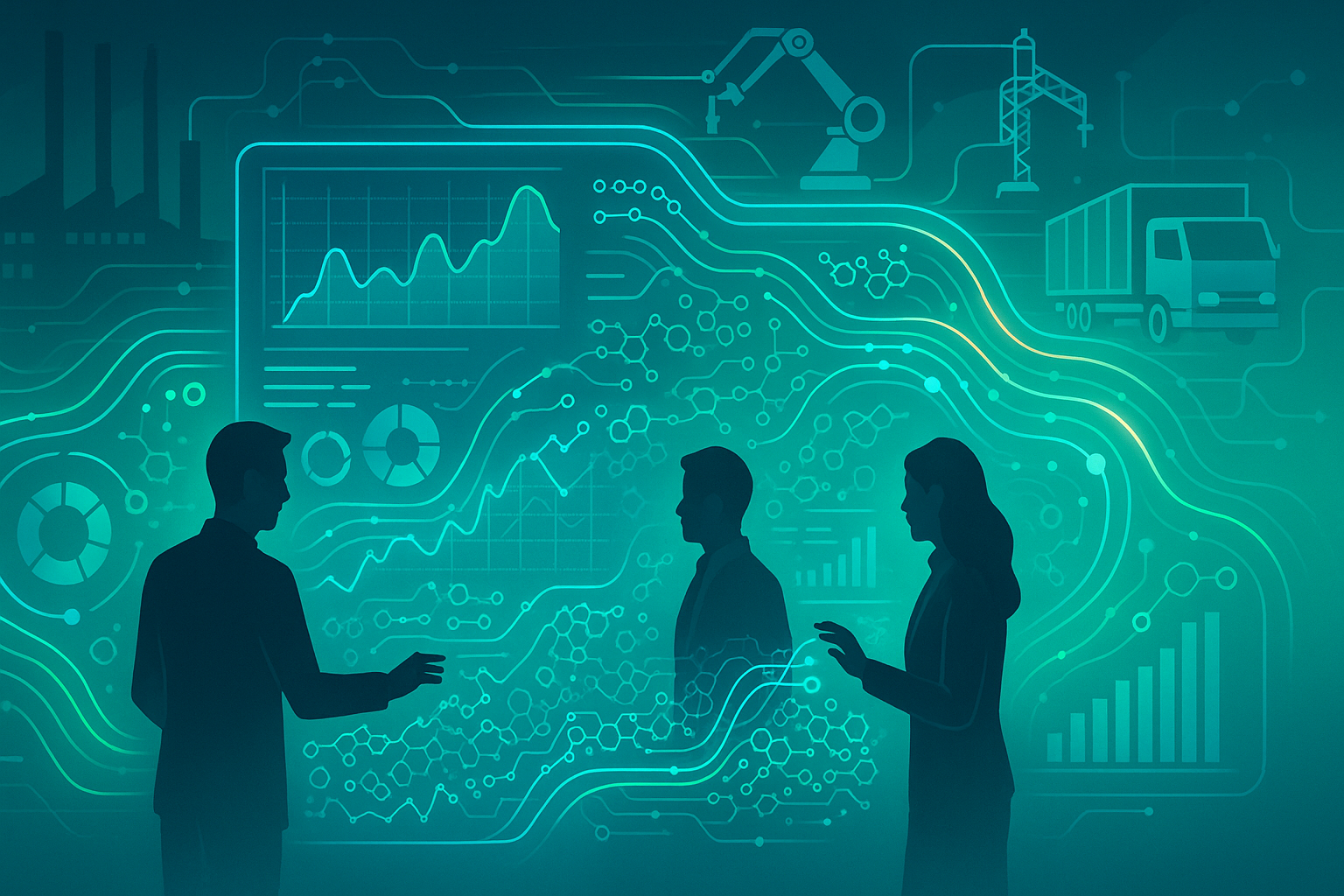
I want to make an argument that sounds grandiose and is, annoyingly, mostly true: the operating system of the modern economy is not a market, or a currency, or a central bank. It is a database with permissions, a workflow engine, and a tab open to the general ledger. It is called ERP, and it is the most consequential software almost nobody outside of work has heard of.
ERP stands for Enterprise Resource Planning, which is three words chosen specifically to make you stop reading. Underneath the name is the system that decides, for a large chunk of the physical world, what gets made, what gets bought, who gets paid, and when. The thing economists draw as a tidy supply-and-demand curve, a company experiences as a screen with forty-one fields and a “Post” button that is, somehow, the scariest button in the building.
The flat statement, said flatly
Here is the absurd premise, stated plainly because that is the house style: a great deal of “the economy” is a few enterprise software vendors and the consultants who configure them.
When a multinational decides how much steel to order, the answer does not come from a boardroom epiphany. It comes from a materials-requirements-planning run inside an ERP system, executed against forecast data, lead times, and reorder points that someone — possibly someone billing $300 an hour — typed into a configuration table in 2014 and nobody has revisited since. Classical economic constructs (resource allocation, marginal cost, supply-demand equilibrium) are real, and they are also, in practice, a settings page.
This is not a knock. It is the actual achievement. ERP took a couple centuries of economic theory and made it executable. Davenport’s 1998 Harvard Business Review piece, “Putting the Enterprise into the Enterprise System,” made the point that still holds: these systems don’t just support the business, they encode it. The org chart, the approval chain, who is allowed to spend what — all of it gets frozen into software. Install ERP and you are not buying a tool. You are casting your company’s operating assumptions in concrete and then living in the building.
“Operating system” is a claim, not a metaphor
I keep calling ERP the operating system of the economy, and I want to be precise about what I mean, because the word “operating system” is doing real work and not just sounding important.
An operating system does three things: it allocates scarce resources, it mediates between everything that wants those resources, and it enforces who is allowed to do what. That is also, exactly, an ERP system, scaled up from one machine to one enterprise — and, in aggregate across enterprises, to a meaningful slice of global production. Capital, labor, materials, and information all get scheduled, contended over, and permissioned through it.
The mastery that used to win in industry was being good at the physical thing: the factory, the logistics, the scale. Increasingly the mastery that wins is being good at configuring the substrate the physical thing runs on. Seddon, Calvert, and Yang’s 2010 MIS Quarterly study “A multi-project model of key factors affecting organizational benefits from enterprise systems” put numbers on a version of this: the benefit doesn’t come from owning the software, it comes from the integration and the process discipline around it. The license is the cheap part. The competence is the moat.
Now the part where AI shows up and everyone loses their minds
Here is where the genre demands I tell you AI changes everything. So let me tell you what AI actually changes, which is more specific and less thrilling than the keynote.
ERP plus machine learning gives you a few real things: demand forecasts that update faster than a quarterly planning cycle, anomaly detection on transactions that used to require an auditor and a long weekend, and supply chains that re-plan when a port closes instead of when a human notices the port closed. There is a genuine research frontier here — Huang et al.’s 2020 review in IEEE Access, “Artificial Intelligence in Enterprise Resource Planning Systems”, is a reasonable map of what’s been tried and what’s still mostly a slide.
That word “mostly” is load-bearing. The honest state of things, as of writing, is that the dramatic version — the self-driving enterprise that reconfigures itself toward some shared corporate telos — is a research direction and a sales narrative, not a product you can buy and trust unattended. The boring version — better forecasts, fewer reconciliation hours, faster replanning — is real, shipping, and worth money. The gap between those two versions is where roughly all of the hype lives, and where roughly all of the failed implementations come to die.
Because the dirty secret of “AI in ERP” is the same as the dirty secret of plain old ERP: the model is only as good as the master data, and the master data is a mess. You can bolt the most advanced inference engine in the world onto a system where three departments spell “Customer” four different ways, and what you will get is a very confident, very fast wrong answer. The AI does not fix your data hygiene. It launders it into something that looks authoritative, which is worse.
The consultant is the load-bearing human
This is the part of the source material I came in skeptical of and left agreeing with, so I’ll keep it.
The traveling enterprise consultant — the person who lands in a new industry every eighteen months, configures the same software against wildly different realities, and leaves — is doing something underrated. They are a carrier of patterns. They have seen what the German auto supplier did, and they bring it, slightly mutated, to the Brazilian mining firm. Hedman and Borell’s 2004 paper in the Journal of Enterprise Information Management, “Narratives in ERP systems evaluation,” frames implementations as stories an organization tells about itself, and the consultant is, whether they’d put it this way or not, an itinerant editor of those stories.
I will not oversell it. A lot of consulting is also a slide deck wearing the confidence of a science. But the genuinely good ones are doing real epistemological work: they are the mechanism by which a hard-won lesson at one company doesn’t die at that company. They turn one firm’s expensive mistake into another firm’s cheap default. That is not nothing. That is, arguably, how industrial knowledge actually propagates now that it lives in config tables instead of in the heads of foremen.
The cautionary canon
If you want evidence that this matters — and that it’s hard — the case studies are right there, and the useful ones are the painful ones:
- Nestlé. The famous one. A multi-year, multi-hundred-million-dollar SAP rollout that became a CIO Magazine cautionary tale (Worthen’s 2002 “Nestlé’s ERP Odyssey”) precisely because the company tried to standardize processes that the business units had no intention of standardizing. The lesson everyone quotes: ERP is an organizational-change project wearing a software costume. The software was never the hard part.
- Siemens and Tata Steel are cited (Kumar and van Hillegersberg’s 2000 Communications of the ACM piece on ERP evolution; the supply-chain integration work at Tata) as the other side — harmonization that did pay off. The difference between the success stories and the odysseys is almost never the technology. It’s whether the humans agreed to change before the system forced them to.
I am summarizing these from the literature, not from having sat in those project rooms. Treat them as the well-documented examples they are, not as my firsthand war stories.
The actual thesis, minus the robes
So here is what I’m actually claiming, stripped of the academic vestments the source material was wearing:
The most important software in the economy is the least glamorous. It runs quietly, it encodes more of how the physical world operates than any market diagram admits, and the people who can configure it are holding a kind of economic agency that doesn’t show up in any photo of a factory floor. AI makes the boring parts faster and the forecasts sharper, and it tempts everyone to believe in a self-driving enterprise that, as of today, does not exist and would be terrifying if it did. The bottleneck was never compute. It was, and remains, clean data and humans who’ll agree on what a “customer” is.
There is no command at the end of this one. There is just a quiet recommendation: the next time someone tells you a market did something, ask what software actually executed the decision. The answer is usually a database with permissions, and the answer is usually more interesting than the market.